![[Headline]](../technik/sonstige/headtran.gif)
![[IMAGE]](../bilder/steinwa.jpg) |
Author: Publisher: No. of Players: |
![[IMAGE]](../technik/box/rot/rot-5.gif) ![[IMAGE]](../technik/box/gelb/gelb-7.gif) ![[IMAGE]](../technik/box/grun/grun-8.gif) ![[IMAGE]](../technik/box/pink/pink-7.gif) ![[IMAGE]](../technik/box/blau/blau-7.gif) |
|
The Fantasy-Wargame Insel der Steinernen Wächter (Island of the Stone Guardians) by ELFENHERZ SPIELE first captured my eye with its unusual looking gameboard (or better: playing area). Whereas I have seen many games containing a modular gameboard which can be mounted in different ways, I do not think that I have yet met a game which uses a plain blue underlay on which islands consisting of several hexagonal provinces are placed. First to be placed is the central island of Lutao which actually features a border of blue sea areas around its land masses, and then all other islands are added so that they either touch the sea area around Lutao or any other island which was already placed. Despite the fact that the underlay does not contain any kinds of spaces, the hexagonal shape of all land masses and the mentioned placement rules ensure an even distribution of all islands, and as you might guess this variable setup offers a lot of variety from one game to the next. The game itself seems a bit more traditional, with each player receiving a starting hand of province cards in which a certain amount of army markers can be distributed. In the course of the game the players will compete to conquer the central city of the island of Lutao, representing the former capital of the whole realm from which the races of the players were ousted when several powerful sorcerers decided to claim the land of Lutao for themselves. Now the sorcerers have died, but the fame of the riches of Lutao still is alive with the different player races, and so are also the huge Stone Golems which the sorcerers had created to destroy all races who should try to return to Lutao. 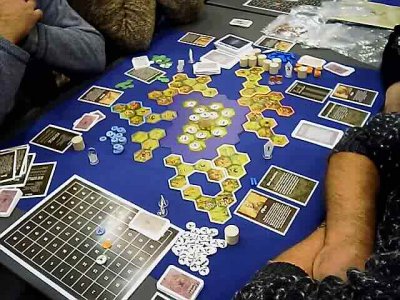 The number of provinces occupied by a player also determines the major part of a player's income. Additional income is generated by each city or complete island a player possesses, and furthermore the occupation of any province of the central island of Lutao is also rewarded. A player uses his income to purchase armies, ships, cities and movement markers, but whereas income is collected and purchases are made at the end of a player's turn any placement of newly acquired markers is made at the beginning of the player's next turn. In their turns the players have the possibility to move their armies on land or to make a sea movement with armies embarking from a province containing a ship. However, whereas the land movement is a simplistic movement of each army into a neighbouring hex, the sea movement is somewhat resourceful since it uses movement markers which must be acquired by the players. These movement markers are short wooden sticks, and if a player wants to make a sea movement he must place a continuing path of movement markers from the province in which his armies and the ship are located to the province where the armies should make landfall. The movement markers are discarded after the sea movement, and the use of these markers cleverly negates any need of hex spaces on the blue underlay, since the whole measuring of distances is effectively dealt with through the movement markers. Players are allowed to test in the purchase phase whether they have acquired enough movement markers, but apart from the fact that this would reveal their next action to the other players it perhaps might be an interesting variant to prohibit any advance measuring. Especially in times where a player is tight on cash the movement markers might prove themselves to be tricky, since the players then would need to estimate how many markers they might need to make a movement, and so they would have to balance their wish to buy additional armies against the certainty of a sea voyage. Whenever the armies of two players meet in a province a battle arises. The players have no regular possibility to withdraw, but they must fight the battle right till the end. The results of each battle round are determined by a partially randomized method, but instead of rolling some dice the players actually draw a hand of cards from their own decks of combat cards. The number of cards depends on the number of participating armies plus one (up to a maximum of four cards), and each player choses one of these cards which he puts back below his deck of combat cards before he reveals the other cards to his opponent. All cards are acted on simultaneously, and so cards for defence, misses, hits, hits against armies in a city and heroic hits (2 armies or one army in a city) are included. Both players remove their destroyed armies, and combat goes into another round with both players drawing new combat cards until only one player has no armies left. My first thought of the combat cards was that they are a fanciful replacement of dice with no additional use, but once you have started playing you will actually discover that this observation is wrong. Combat cards used by a player are discarded, and the discarded cards only are returned to play when a player's stack of combat cards is exhausted. Thus, it matters very much which cards a player choses to place back below his stack of combat cards at the beginning of each round of combat, since if the players want to avoid too many miss cards this way they will get their punishment in a later combat when they have to face all those cards which they did not want to meet earlier. While it is difficult to gain insights into the deck construction of the other players through their success in combat, some valuable hints may be gained at which times a player may be more vulnerable, and so the players should be aware of "bean counters" who try to memorize the number of used hits and misses in order to determine the right moment for a crucial strike. On the island of Lutao the Golems are waiting, and a player must fight his way through at least one of the provinces containing Golems before he actually can try to occupy the central city. If he succeeds, he will need to keep his occupation of the city for two additional turns in order to win the game. As usual with such "capture the flag" games, the other players burst into activity if a player seems to get too close to the city of Lutao, but in Insel der Steinernen Wächter the first player to reach the city gets the strong advantage that he gains control over the Golems. Thus, in every turn he gets a number of Golem actions equal to the number of his competitors, and these actions either may be used for adding new Golems at an unoccupied province or for moving and attacking with Golems from a province. 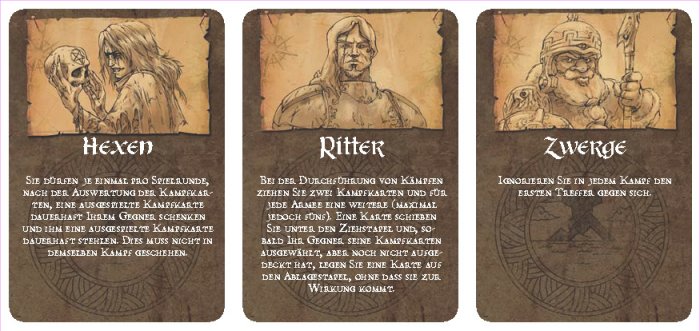 The game is spiced up by special abilities. Thus, each player has a unique race with a permanent special ability, and furthermore each player receives a rune which gives him another special ability. Most of these abilities are focused on movement and combat, but some others are concerned with gaining additional troops, spell cards etc. Talking about spell cards, these cards may be drawn if a player is in possession of one or more cities, but even though these spells once again offer benefits for movement and combat, they differ from the races and runes because they are not of permanent durability. Thus, a spell can only be used once and then must be discarded, but on the other hand the players usually have access to replenishments through their cities. Most of the ingredients used in Insel der Steinernen Wächter like hex-spaces, combat cards or special abilities seem well known from other games, so that the question might be asked why the game actually should be purchased. However, due to the addition of some minor innovations and an good mixture of these ingredients the game creates an interesting challenge for the players, and it can be replayed with a different setup situation every time the game comes onto the table. Here it should be mentioned that some of the special abilities which can be encountered in the game seem stronger than others, but all players still have a more or less equal chance to win because they can chose their combination of race and rune during the setup phase from a handful of races and runes, and during the course of the game it becomes quite interesting to make the best of the chosen combination. A big plus in comparison to some other epic battle games is the simple elegance of both the movement and combat mechanisms, and the author wisely has chosen not to overburden gameplay with too many options like different types of units or different landscapes, since a too sophisticated set of rules would have changed the general spirit of the game. As a matter of fact, the chosen balance between variety (special abilities) and simplicity (rules of low complexity) seems to be almost perfect, and so the game actually compares to some degree with classics Wizard's Quest, but it offers a higher density in terms of story elements and strategic options. Adding a purist but accommodating graphic design, Insel der Steinernen Wächter can convince strategy players who should not be put off by the whiff of understatement which may be felt on first sight. If you want to learn more about the game, you might want to have a look at the Elfenherz website where English rules and card translations can be downloaded. | ||
 | |

Looking for this game? Visit Funagain Games! |
|
|
| |
|
Impressum / Contact Info / Disclaimer Kulkmann@aol.com
Copyright © 2009 Frank Schulte-Kulkmann, Essen, Germany | |
![[Gamebox Index]](../technik/headpage/head8.gif)